
Commercial Coffee Brewers That Help Your Business Serve Better Coffee

Commercial Coffee Brewers That Help Your Business Serve Better Coffee
Espresso is the centre of most café menus, but it is not the only coffee experience your business can offer. Commercial coffee brewers batch brewers, pour over systems, and cold brew equipment expand your menu, serve different customer preferences, and increase the revenue potential of every customer visit. For businesses that serve high volumes of black coffee alongside their espresso programme, a quality commercial coffee brewer is as important an investment as the espresso machine itself. This guide covers the types available, what each suits, and how to choose the right one for your operation.
Why Commercial Coffee Brewers Belong in Your Business Setup
Not every customer drinks espresso-based beverages. A growing segment of Indian café customers actively prefers filter coffee, pour over, or cold brew, particularly among specialty coffee enthusiasts and health-aware customers who prefer lower-acid options. Commercial coffee brewers serve this segment at scale, with consistent quality and speed that manual brewing cannot replicate across a busy service period. For offices and hospitality environments, batch brewers provide the simplest and most efficient way to keep a large number of people consistently supplied with quality coffee throughout the day.
Types of Commercial Coffee Brewers
Batch Brew Machines
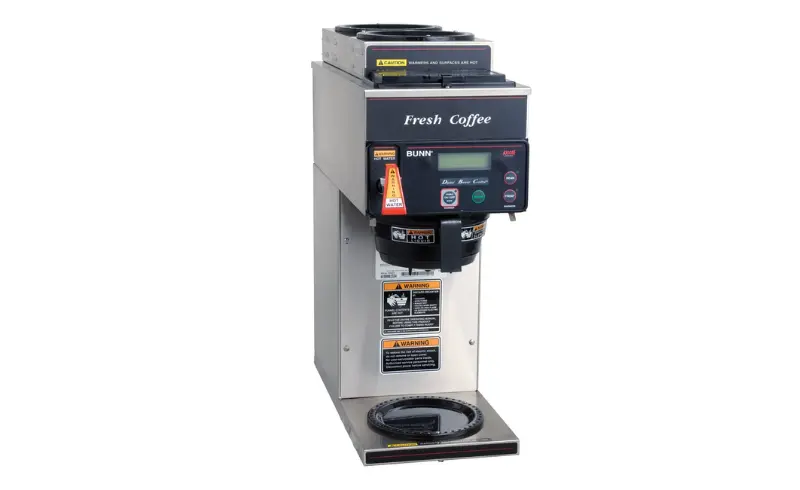
Batch brew machines are the most widely used commercial coffee brewers in café, office, and hospitality environments. They brew large quantities of filter coffee typically two to four litres per cycle at consistent temperature and extraction parameters, delivering a clean, smooth cup of black coffee that holds well in a thermal carafe for up to an hour. For cafés that receive morning rushes with consistent demand for filter coffee, a quality batch brewer such as a BUNN commercial unit allows the team to serve dozens of cups per cycle without any per-cup preparation time, freeing baristas to focus on the espresso bar.
Pour Over and Manual Brewers
Pour over brewing produces a clean, nuanced cup that highlights the origin character of the coffee in a way that batch brewing and espresso cannot. For specialty cafés with an origin-focused menu, a pour over bar using Hario V60, Kalita Wave, or similar systems adds a high-engagement, high-margin menu item that experienced coffee drinkers seek out. Manual brewers are low investment items that generate significant perceived value and differentiation when presented well. They also work as educational touchpoints, giving baristas an opportunity to talk about the coffee they are serving.
Cold Brew Systems
Cold brew is a steeped extraction method that produces a smooth, low-acid concentrate over a 12 to 24 hour period. For businesses, cold brew concentrate is the base for multiple menu items straight cold brew, cold brew lattes, nitro cold brew, and flavoured cold brew variations from a single production batch. The Toddy cold brew system, available through Kaapi Machines, is the original commercial cold brew pioneer and produces a consistently smooth concentrate without requiring electrical equipment. For cafés that want to offer nitro cold brew as a premium menu item, the Brood nitro system infuses cold brew concentrate with nitrogen to create a creamy, naturally sweeter pour that is among the highest-margin cold beverages a café can serve.
What to Consider When Choosing a Commercial Coffee Brewer
- Volume and Cycle Time: Match the batch size and brew cycle time to your peak-hour demand. A 2-litre batch brewer covers a small café morning service. A 4-litre unit suits high-volume environments or offices with large teams.
- Temperature Control: Commercial coffee brewers should maintain a consistent brew temperature between 90 and 96 degrees Celsius. Machines with poor temperature consistency produce uneven extractions across batches.
- Holding Time: If coffee will be held in a carafe between service cycles, a machine with a quality thermal carafe rated to hold flavour for 60 minutes or more is essential. Avoid models that use warming plates, which cause coffee to stale rapidly.
- Compatibility with Your Espresso Programme: For cafés that want to run both an espresso bar and a filter coffee programme, ensure the coffee brewer uses the same beans or a compatible grind specification to simplify inventory and training.
- Ease of Cleaning: In a commercial environment, brewers that require complex daily cleaning routines will not be maintained consistently. Machines with accessible brew baskets, removable carafes, and simple rinse protocols reduce the maintenance burden on your team.
Who Benefits Most from Commercial Coffee Brewers
Specialty cafés use commercial coffee brewers as part of a three-format menu alongside espresso and cold brew, allowing them to serve the full range of coffee preferences without compromising quality in any category. Offices use batch brewers as the primary coffee service solution for large teams, delivering consistent filter coffee at high volume without requiring barista skills. Hotels and restaurants use batch brewers for breakfast service and meeting rooms, where speed and volume are the priority. QSR operators use commercial coffee brewers to serve consistent coffee quickly at a lower price point than a full espresso programme requires. For any business where black coffee is part of the service offering, a commercial brewer delivers better results than a domestic machine and better efficiency than per-cup manual brewing.